Blum Tandem Drawer Slides: A Woodworker's Field Guide to Sizing, Locking Devices, and the Bore That Trips Everyone Up
The Austrian hardware is bulletproof once it's installed — but getting there means decoding a confusing part matrix, cutting a notch most people forget, and ordering twice as many locking devices as you think you need.
The 563 vs. 569 Decision You Make Before Anything Else
Blum's Tandem plus Blumotion line splits into two load classes that look nearly identical on the shelf. The 563H handles 100 lbs per pair; the 569H bumps that to 150 lbs. Both are full-extension, soft-close undermount runners, but they share one critical sizing constraint: the H suffix means they're built for drawer side material between 1/2" and 5/8" thick. Blum also sells a 563F and 569F variant sized for 3/4" material — a different beast entirely, and one that will not seat correctly on thinner plywood. Grab the wrong letter and the locking mechanism won't engage. The H designation is the standard choice for shop-built drawers in prefinished 1/2" plywood, which is the most common material for home workshop builds.
Locking Devices: You Need Twice as Many as You Think
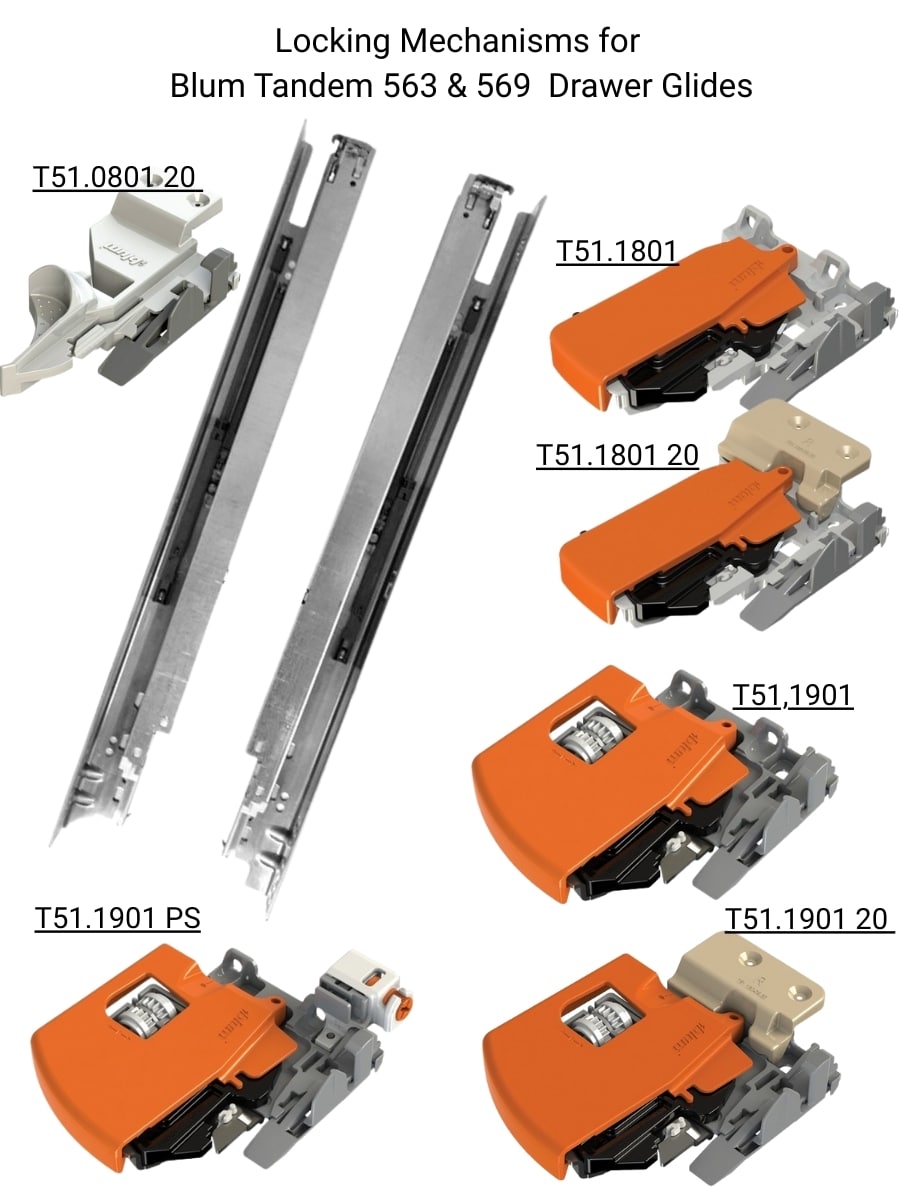
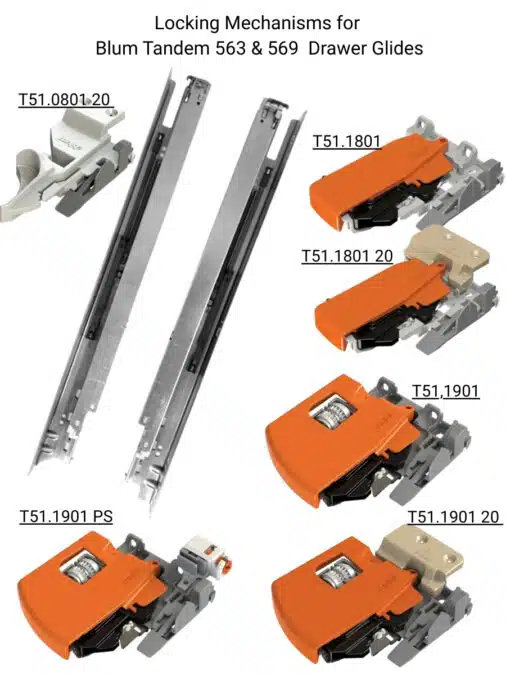
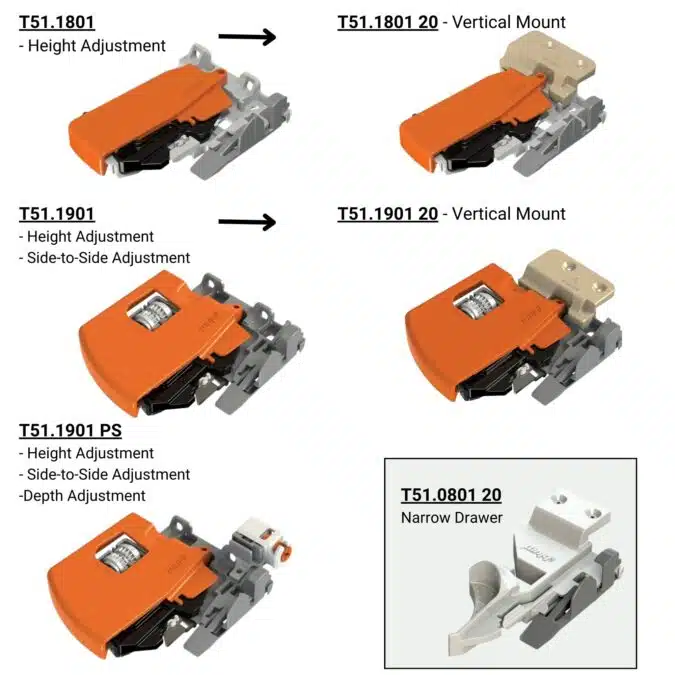
Every pair of Tandem runners requires two locking devices — one right, one left — that clip onto the front of the drawer and mate with the slide mechanism. They are sometimes sold as a pair, but many retailers list them individually, so a single drawer means ordering two separate pieces. The part number hierarchy matters. The T51.1801 offers height adjustment only. The T51.1901 adds side-to-side correction. The T51.1901 PS gives height, side-to-side, and depth adjustment — the most forgiving option for a first-time build. Each of these also comes in a "20" vertical-mount variant that adds a lip for driving screws into the edge of the drawer sub-front rather than into its backside. Woodworkers using prefinished 1/2" plywood tend to avoid the vertical mount because screwing into the edge of thin plywood risks splitting the veneer. The T51.0801 20 is a separate vertical-mount device sized specifically for narrow drawers, with height adjustment only.
Sizing the Drawer Box: The 5/8" Rule
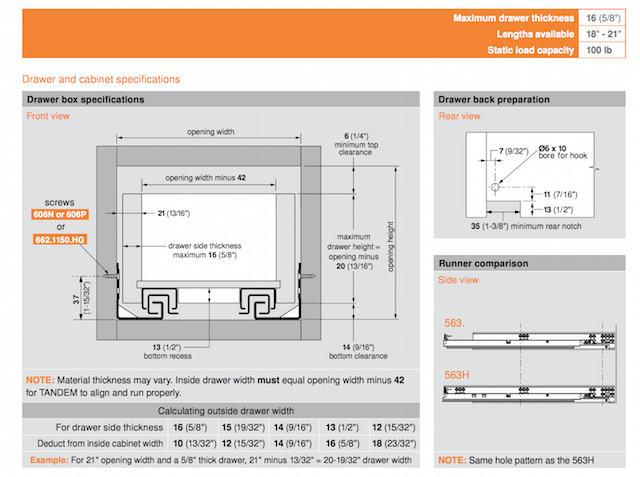
The math for drawer width is simpler than Blum's instruction sheets make it look. Measure the cabinet opening. Subtract 5/8". That is the outside width of the drawer box — no further calculation needed when the side material is 1/2" plywood. The sides should run the full length of the drawer. The front and back sit inside the sides, which means their width is the outer width minus 1" (two 1/2" side panels). This inside-the-sides construction gives the undermount runners clearance to seat beneath the drawer without interference from end grain or face-frame overhang. The 5/8" gap accounts for the combined thickness of the two runners plus the small clearance Blum requires for the soft-close mechanism to cycle without binding.
The Notch and Bore That Catch Every First Build
The back edge of each drawer side needs two features cut before assembly: a bore and a notch. The bore is 1/4" in diameter and 1/4" deep — a shallow hole that receives the rear hook of the Tandem runner. Drilling this on a 1/2" plywood panel leaves only 1/4" of material behind the hole, and punching through is a common mistake that has almost no visible consequence on a finished drawer. The notch sits directly in front of the bore and measures 1/2" tall by 1 3/8" wide at minimum. It accommodates the runner's rear clip. A jigsaw handles the cut cleanly. Doing both operations before gluing up the box is far easier than trying to reach a router or jigsaw blade into an assembled drawer. Several shop-built jigs exist for holding the drawer back at the correct height so the bore lands in exactly the right spot without measuring each side individually.
Joinery That Won't Sabotage the Bottom Panel
The drawer front and back can attach to the sides with locking rabbets, loose tenons, dowels, or pocket screws. Pocket screws are the most accessible option for a shop without a domino or doweling jig, but one trap catches builders repeatedly: a pocket hole drilled into or near the bottom groove will prevent the plywood bottom panel from sliding into place during assembly. The screw shank blocks the groove even if the head sits flush. Mark the groove location on every side piece before drilling pocket holes, and keep every hole at least 1" away from that line. The bottom panel itself should be dry-fit before any glue-up to confirm it slides freely from front to back without catching on a stray screw tip or glue squeeze-out in the groove channel.
Installation Is the Easy Part
Once the drawer boxes are built and the bores and notches are cut, the actual slide installation moves quickly. The runners mount to the cabinet sides with standard European screws, and the drawer drops onto them from above — the rear hook seats into the bore, the front locking device clicks into the runner, and the drawer is in. Height, side-to-side, and depth corrections happen at the locking device if you spec'd the T51.1901 PS. The Tandem plus Blumotion mechanism handles soft-close damping automatically once the drawer is within the last 2" of travel. No batteries, no adjustments to the damping unit itself. The full extension means the drawer box pulls completely past the cabinet face, giving full access to contents at the rear — a feature that distinguishes these from three-quarter-extension side-mount slides that leave the last few inches of drawer hidden inside the cabinet.
Keep reading

Ten DIY Candle Holders: From Scrap Wood and Concrete to Dyed Veneer and Clay
A week's crop of candle-holder builds using everyday materials—cardboard boxes, fence posts, pallets, and oven-baked clay—each with a specific step or tool to get right.
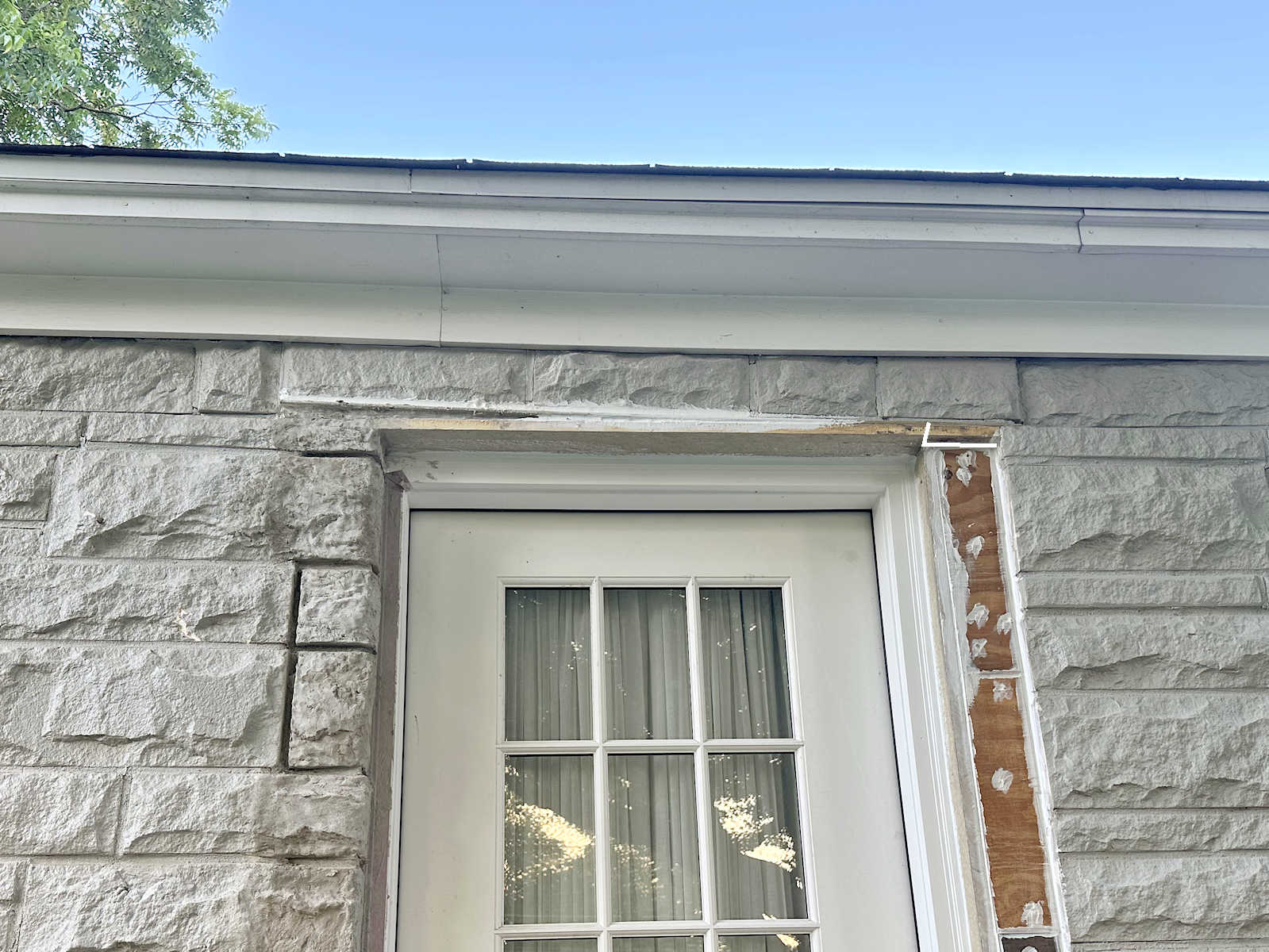
Two DIY Projects, One Lesson: Patience and the Right Tools Beat Speed Every Time
From faux stone door surrounds to perfect wood circles, these home projects prove that working in stages and choosing specialized guides over brute force delivers cleaner results.

6 Auto-Insurance Moves That Lower Your Premium, Not Your Protection
Understanding full coverage, using repair costs to set deductibles, cleaning your record, stacking discounts, weighing service over price, and blending digital quotes with human advice—these six tactics cut costs without cutting coverage.